Need assistance? Call us at : 0704328523

-1% Off
Compare
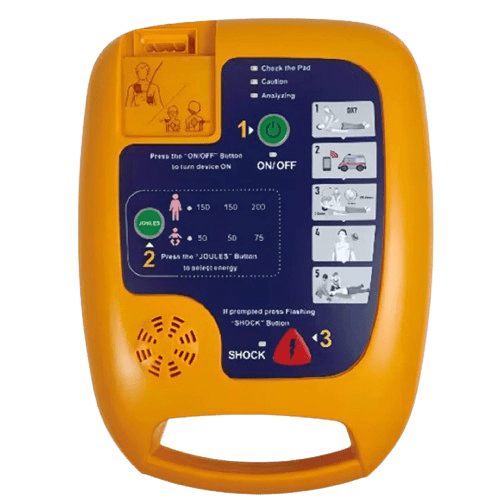
Medical AED defibrillator in Kenya.
Original price was: KSh 131,000.00.KSh 130,000.00Current price is: KSh 130,000.00.
Fast, reliable AED defibrillators for sudden cardiac arrest—easy to use, life-saving technology. Shop now for peace of mind.
Description
Description
An AED (Automated External Defibrillator) is a portable electronic device used to treat sudden cardiac arrest (SCA) by analyzing the heart’s rhythm and, if necessary, delivering an electric shock (defibrillation) to help the heart re-establish an effective rhythm.
🔹 An Automated External Defibrillator (AED) is a portable medical device that automatically diagnoses life‑threatening cardiac arrhythmias (such as ventricular fibrillation and pulseless ventricular tachycardia) and, if needed, delivers an electric shock (defibrillation) to help the heart re‑establish a normal rhythm. Wikipedia+2U.S. Food and Drug Administration+2
Medical AED Defibrillator – Automated External Defibrillator in Kenya
The Medical AED Defibrillator (Automated External Defibrillator) supplied by Doctor Ally East Africa is a life-saving emergency device designed to deliver an electric shock to restore a normal heart rhythm during sudden cardiac arrest. This easy-to-use device is essential for rapid response in both medical and public settings.
Widely used in hospitals, ambulances, offices, schools, airports, and public spaces across Kenya and East Africa, the AED helps increase survival chances during cardiac emergencies.
Key Features of the AED Defibrillator
✔ Fully automated operation with voice and visual prompts
✔ Delivers controlled electric shock when needed
✔ User-friendly design suitable for trained and non-medical users
✔ Portable and lightweight for emergency response
✔ Built-in safety mechanisms to prevent misuse
✔ Long-life battery and replaceable electrode pads
✔ Quick response time for critical situations
Clinical Applications
AED defibrillators are used in:
Emergency response to sudden cardiac arrest
First aid and resuscitation procedures
Public access emergency programs
Ambulance and hospital emergency care
They are critical in managing life-threatening conditions such as Sudden Cardiac Arrest and severe arrhythmias like Ventricular Fibrillation.
Benefits for Facilities in Kenya
Increases survival rates during cardiac emergencies
Easy to use with minimal training required
Essential for workplaces and public safety compliance
Portable for rapid emergency deployment
Reliable device for hospitals, schools, and public institutions
Technical Specifications (May Vary by Model)
Product Type: Automated External Defibrillator (AED)
Operation: Fully automatic or semi-automatic
Output: Controlled defibrillation shock
Display: LED indicators or screen (model dependent)
Power Source: Rechargeable or replaceable battery
Accessories: Electrode pads, carry case
Why Buy AED Defibrillators from Doctor Ally East Africa?
Trusted emergency medical equipment supplier in Kenya
High-quality life-saving devices
Competitive pricing for institutions and organizations
Training support and after-sales service available
Fast delivery within Nairobi and across East Africa
Order AED Defibrillators in Kenya Today
Doctor Ally East Africa supplies reliable AED defibrillators in Kenya designed to provide rapid response and improve survival outcomes during cardiac emergencies.
📞 Contact us today +254704328523 for pricing, bulk orders, and nationwide delivery across Kenya and East Africa.
What an AED Does:
Analyzes the heart rhythm of a person in cardiac arrest.
Determines if a shock is needed to correct a life-threatening arrhythmia (like ventricular fibrillation or pulseless ventricular tachycardia).
Delivers a shock automatically or prompts the user to press a button to deliver it.
🔹 Key Features of an AED:
| Feature | Description |
|---|---|
| Automated Analysis | Detects abnormal heart rhythms and decides whether a shock is needed. |
| Voice and Visual Prompts | Guides users step-by-step with audible instructions and sometimes visual cues. |
| Shock Delivery | Delivers electric shock manually (semi-automatic) or automatically (fully automatic). |
| Electrode Pads (Pads) | Adhesive pads placed on the chest to monitor and deliver shock. |
| Built-in Safety Features | Won’t deliver a shock unless it’s needed; minimizes harm to the patient. |
| Battery Operated | Portable and powered by rechargeable or replaceable batteries. |
| Self-Test Function | Regular self-checks to ensure readiness for emergency use. |
| CPR Feedback (Advanced models) | Some offer real-time CPR feedback (rate, depth, etc.) to improve rescue quality. |
| Child Mode or Pediatric Pads | Allows safe use on children or infants with reduced shock energy. |
🔹 Who Can Use It?
AEDs are designed for use by non-medical personnel, including:
First responders
Workplace employees
Bystanders in public places
Training improves effectiveness, but many AEDs are usable without prior training due to clear, guided instructions.
Here’s a step-by-step guide on how to use an AED (Automated External Defibrillator) in an emergency:
🩺 How to Use an AED – Step-by-Step
⚠️ Always ensure your safety and call emergency services (e.g., 911) before beginning AED use.
Step 1: Check the Scene & Person
Ensure the area is safe.
Check the person for responsiveness (tap and shout).
If unresponsive and not breathing or only gasping, call emergency services and start CPR immediately.
Step 2: Turn On the AED
Open the AED case and turn the device on (button or lid depending on the model).
The AED will begin to give voice prompts and visual instructions.
Step 3: Expose the Chest
Remove clothing from the person’s chest.
Make sure the chest is dry and free of hair where pads will be placed.
Use the razor or cloth (usually included in AED kit) if needed.
Step 4: Attach the Pads
Peel the backing off the electrode pads.
Place the pads on the person’s chest as shown on the pads:
One pad on the upper right chest (just below collarbone).
One pad on the lower left side (below armpit).
Step 5: Let the AED Analyze
Ensure no one is touching the person.
The AED will analyze the heart rhythm.
The device may say “Analyzing heart rhythm. Do not touch the patient.”
Step 6: Deliver the Shock (if advised)
If the AED advises a shock:
Make sure no one is touching the victim.
Press the shock button when prompted.
If no shock is advised, AED will prompt you to continue CPR.
Step 7: Resume CPR
Immediately begin CPR (30 compressions and 2 breaths) after the shock or if no shock is advised.
Continue CPR for 2 minutes, then let the AED re-analyze.
Repeat the process as instructed by the AED until emergency services arrive or the person responds.
🚑 Important Reminders:
AEDs are designed for ease of use by anyone—even without medical training.
Do not remove the AED pads between shocks or CPR unless instructed.
If using an AED on a child under 8 or 25 kg (55 lbs), use pediatric pads if available.
✅ Trusted Resources:
American Heart Association (AHA):
https://cpr.heart.orgRed Cross AED Training:
https://www.redcross.org
Reviews (0)
Reviews
There are no reviews yet.