
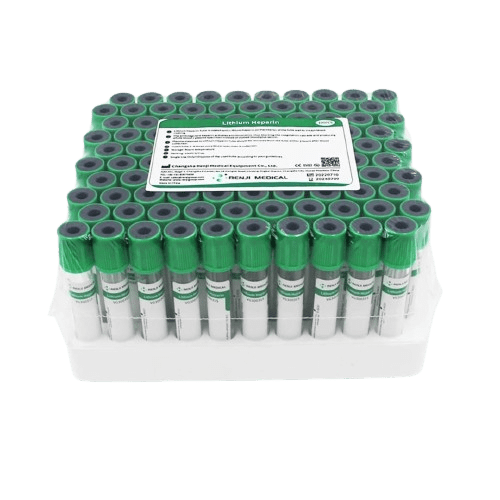
🧪 What is a Sodium Heparin Vacutainer?
A sodium heparin vacutainer is a sterile, vacuum-sealed blood collection tube that contains sodium heparin—an anticoagulant that prevents blood from clotting by inhibiting thrombin and other clotting factors.
Sodium heparin vacutainers are blood collection tubes used primarily for collecting blood samples for plasma-based tests, especially in clinical chemistry and certain specialized tests like blood gas analysis and cytogenetics.
A sodium heparin Vacutainer is a specialized blood collection tube that contains sodium heparin as an anticoagulant additive. It is used to collect whole blood or plasma and prevent clotting by inhibiting the coagulation cascade. Heparin acts by binding to antithrombin, which then inactivates thrombin and factor Xa, thereby halting clot formation. shop.gbo.com+3fishersci.ie+3bd.com+3
These tubes are commonly used in clinical chemistry, biochemistry, and certain immunology tests, where plasma samples are preferred over serum because heparin allows rapid processing without the need for clot formation. Avantor+2bd.com+2
Sodium Heparin Vacutainer – Reliable Blood Collection Tubes for Clinical Testing
The Sodium Heparin Vacutainer is a high-quality blood collection tube designed for the safe and accurate collection of whole blood or plasma samples for clinical chemistry and biochemical analysis. At Doctor Ally East Africa, we supply dependable sodium heparin vacutainers suitable for medical laboratories, hospitals, diagnostic centers, and clinics across Kenya and East Africa.
These vacutainer tubes contain sodium heparin anticoagulant, which prevents blood clotting while preserving plasma integrity for accurate laboratory testing.
Key Features of Sodium Heparin Vacutainers
Pre-Measured Sodium Heparin Anticoagulant – Ensures correct blood-to-additive ratio
Prevents Blood Clotting – Ideal for plasma-based laboratory tests
Leak-Proof Stopper & Secure Seal – Minimizes contamination and sample loss
Clear Tube with Label Area – Easy sample identification and traceability
Medical-Grade Plastic or Glass Construction – Durable and safe for laboratory use
Compatible with Standard Laboratory Analyzers – Suitable for routine clinical chemistry testing
Applications & Uses
Sodium heparin vacutainers are commonly used for:
Clinical chemistry and biochemical analysis
Plasma testing and assays
Emergency laboratory testing
Hospital and diagnostic laboratory procedures
Why Buy Sodium Heparin Vacutainers from Doctor Ally East Africa?
Trusted laboratory consumables suppliers in Kenya & East Africa
Quality products suitable for professional diagnostic use
Competitive pricing for clinics, hospitals, and bulk procurement
Reliable availability and fast delivery across the region
Expert support for laboratory supplies and equipment
Product Specifications (Model Dependent)
Tube type: Sodium heparin vacutainer
Additive: Sodium heparin
Sample type: Whole blood or plasma
Material: Medical-grade plastic or glass
Cap color: Standard heparin color coding
Order Sodium Heparin Vacutainers in Kenya Today
Ensure accurate and reliable laboratory test results with high-quality sodium heparin vacutainers from Doctor Ally East Africa.
📞 Contact us today on +254704328523 to request a quote or place an order for blood collection tubes in Kenya and across East Africa.
More features of Sodium Heparin Vacutainers
1. Green-Colored Cap
Universal color code for heparin tubes.
Often indicates either sodium or lithium heparin—label must specify which.
2. Contains Sodium Heparin Additive
Acts as an anticoagulant to maintain whole blood or plasma state.
Ideal for immediate centrifugation and plasma separation.
3. Vacuum-Sealed Tube
Designed with a pre-set vacuum to draw a precise blood volume (e.g., 2 mL, 5 mL, 10 mL).
4. Plastic or Glass Tube
Tubes are made of either PET plastic (safer, shatter-resistant) or glass (clear visibility).
Sterile and pyrogen-free.
5. Used for Plasma Collection
Prevents clotting, making it suitable for plasma-based tests.
Blood is typically centrifuged after collection to separate plasma.
6. Labelled for Identification
Printed with volume, expiration date, and type of anticoagulant.
Barcode for tracking in laboratory systems.
7. Compatibility with Laboratory Analyzers
Standard sizes allow use with automated blood analyzers.
8. Shelf Life and Storage
Usually has a shelf life of 12–18 months if stored at room temperature (15–30°C).
🧫 Common Test Applications
Plasma electrolyte analysis
Liver and kidney function tests
Blood gas analysis
Chromosome (karyotype) studies in cytogenetics
Immunoassays
⚠️ Important Notes
Not suitable for serum-based tests (since it prevents clotting).
Should be gently inverted (6–8 times) immediately after collection to mix blood with anticoagulant—do not shake, as it may cause hemolysis.



Reviews
There are no reviews yet.